
Definition
Scoliosis is the abnormal sideways curving of the spine (backbone) that begins in infancy, childhood or adolescence.
The spine is made up of the interchange of bones (vertebrae) and discs stacked upon one another running straight down your back.
It is natural for the spine to curve a bit but for people with scoliosis, there is too much curvature of the spine (more than 10 degrees). In these instances, the spine may look like a ‘C’ or ‘S’.
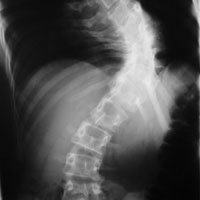
Severe Scoliosis of the Thoracic Spine.
The progression of scoliosis is affected by growth during the first two decades of life.
Early detection, management, and treatment of scoliosis help prevent long-term consequences of the condition.
Symptoms
These are some of the signs and symptoms of scoliosis:
- Uneven shoulders – one shoulder may be higher than the other.
- Uneven waist – one hip may be higher than the other.
- One shoulder blade may appear more prominent than the other.
- Rolling gait.
As the scoliosis gets worse,
- Your child or the young person may start experiencing back pain.
- If the spine starts to rotate as well, the ribs on one side of the chest may become more prominent than the other side.
- Difficulty breathing is a common complication of scoliosis.
- Activities that require chest and belly use often tire the person out.
Causes
There are two types of scoliosis:
- Nonstructural scoliosis
This occurs when no other abnormalities apart from the sideways curve of the spine are seen. The spine itself is structurally normal with no rotation or asymmetry.
The causes of nonstructural scoliosis include:
- Postural cause – where the scoliosis is only apparent when the child is standing and disappears on lying.
- Compensatory mechanism – where the problem is in the legs. When one leg is shorter than the other, the spine naturally curves down to compensate.
- To avoid pain – one example is irritation of the sciatic nerves leading to altered posture to alleviate the pain.
- Infection causing pain in the stomach such as in appendicitis.
2. Structural scoliosis
This is the type of scoliosis where the spine curves sideways and the bones also rotate on top of one another causing asymmetry of the trunk.
The causes of structural scoliosis include:
- Idiopathic – where no associated causes are found. 75–80% of children with scoliosis are idiopathic in nature.
- Neuromuscular diseases – such as cerebral palsy, poliomyelitis, or muscular dystrophy
- Birth defects
- Injury
- Infections
- Tumours such as neurofibromatosis
- Metabolic factors
- Connective tissue disorders
- Rheumatic diseases
References
Taft, E., & Francis, R. (2003). Evaluation and management of scoliosis. Journal of Paediatric Healthcare, 17(1), 42–44.
Risk Factors
These are the risk factors for idiopathic scoliosis, which is the most common type of scoliosis.
- Age – scoliosis typically starts between the ages of 9–15 when the body is growing.
- Gender – girls are at a higher risk of worsening scoliosis and needing treatment for it. However, there is no difference between gender in terms of who gets the disease.
- Family history – scoliosis has been shown to run in families at times. However, the majority of children with scoliosis don’t have a family history of the disease.
Investigations
The main investigation your doctor will request to diagnose scoliosis is a spine X-ray.
Other tests will vary depending on your condition. These may include:
- Lung function test – if the scoliosis has affected your breathing.
- MRI – if there are concerns regarding other symptoms you experience including dizziness and unbalanced walking.
References
Kim, H. J., Blanco, J. S., & Widmann, R. F. (2009). Update on the management of idiopathic scoliosis. Current Opinion in Paediatrics, 21(1), 55–64.
Complications
Most curves, especially small ones, cause no problems at all apart from how the back looks.
- Back pain. This is more common in adults with scoliosis than in teenagers.
- The curve getting bigger. Curves are most likely to grow during a growth spurt. Big curves can keep growing slowly into adult life.
- How the back looks. This is often what bothers teenagers most. One shoulder may sit higher, a shoulder blade may stick out, or there may be a hump on one side when bending forward.
- Breathing problems. This only happens with very big curves, and it is rare.
- Problems from treatment. A brace can rub the skin. An operation has its own risks.
The things people worry about most, like being paralysed or unable to work, are not part of ordinary scoliosis.
Treatment
Treatment will depend on the cause of your scoliosis. For most people in idiopathic scoliosis, watchful waiting or the use of a brace is the mainstay of treatment.
- Observation
- Brace Treatment
- Surgery
A brace can sometimes make the curve smaller, not just stop it getting worse. Wearing the brace for the number of hours advised each day gives the best chance of success.
References
Tang S, Cheung JPY, Cheung PWH. Effectiveness of bracing to achieve curve regression in adolescent idiopathic scoliosis. Bone Joint J. 2024, 106-B(3), 286-292. PMID 38423123.
Seeking Advice
Your Family Doctor (GP)
Your Family Doctor will be able to diagnose and help treat your problem. He or she will be able to
- tell you about your problem
- advise you of the best treatment methods
- prescribe you medications
- and if necessary, refer you to Specialists (Consultants) for further treatment
Prevention
The common type of scoliosis cannot be prevented. It is not caused by bad posture. It is not caused by a heavy school bag. It is not caused by a soft mattress or by sport. No exercise plan has been shown to stop a curve from starting.
What can be changed is what happens next. If a curve is found while a child is still growing, it can be watched. A brace worn during the growth spurt can stop some curves from getting big enough to need an operation.
So a curve should be checked by a doctor, not just watched at home. If you notice uneven shoulders or a hump when your child bends forward, see your doctor.
F.A.Q. | Frequently Asked Questions
What Causes Adolescent Idiopathic Scoliosis?
First, there are many myths about causation (aetiology).
- It is not a postural problem.
- You do not get scoliosis from a soft mattress.
- The carrying of heavy school bags neither causes a curve nor makes an existing one worse.
- You do not get scoliosis from watching too much television and eating too much junk food.
- Scoliosis is not contagious – you cannot catch it from someone who has a curvature.