
Cervical radiculopathy or a pinched nerve occurs when neck pain spreads all the way into your shoulders or arms.
This pain and discomfort is the result of an injury near a spinal nerve root.
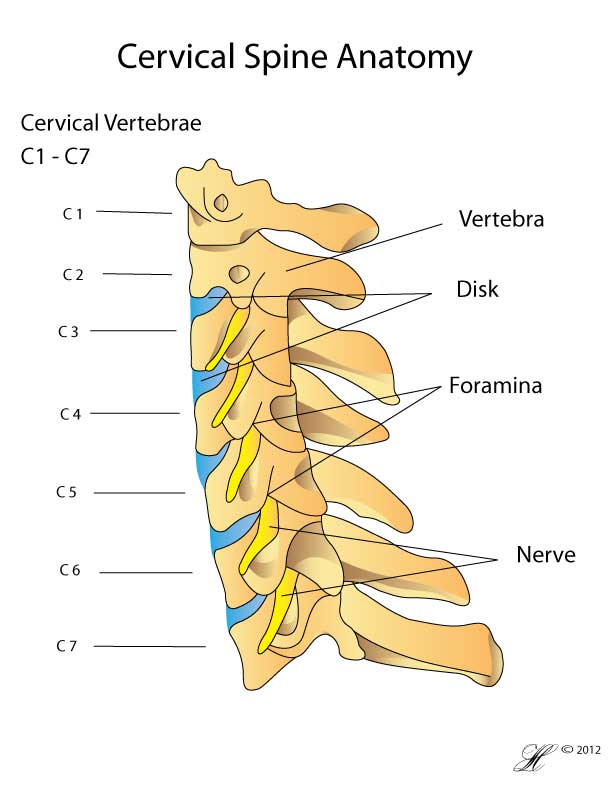
For example, an injury to the vertebrae or discs in your neck (your cervical vertebrae) could result in pain, numbness or weakness in your shoulder, arm, wrist or hand. That’s because the nerves that extend out from between the cervical vertebrae provide sensation and trigger movement in these areas.
Cervical radiculopathy is a very common occurrence.
Symptoms
Every person’s spinal discs go through a series of natural changes as a result of the ageing process. We all can expect some worn discs and a pinched nerve in the back and neck regions throughout life. Not all people will have the same symptoms and pain of cervical radiculopathy, if at all. For some, cervical radiculopathy becomes a serious health threat.
If cervical radiculopathy does develop, patients typically experience pain, particularly down the arm housing the pinched nerve(s). This pain usually manifests as sharp bursts, dull aches, tingling, or even numbness. Some cervical radiculopathy patients may also be gripped by weakness. Some patients also complain that certain movements may worsen the symptoms of cervical radiculopathy. These include extending or straining the neck or turning the head. Specific movements, like placing the hand on the head and stretching the shoulder, actually relieve cervical radiculopathy pain and discomfort.
Causes
Several conditions can put pressure on nerve roots in the neck.
The most common causes for cervical radiculopathy are:
- Herniated cervical disc. In this situation, the outer layer (annulus) of the disc cracks and the gel-like centre (nucleus) breaks through. This causes the disc to protrude, putting pressure on the nerve that exits the spinal column at that point.
- Spinal stenosis. Sometimes, the space in the centre of the vertebrae narrows and squeezes the spinal column and nerve roots.
- Degenerative disc disease. As we age, the water content in our body cells diminishes and other chemical changes occur that can cause the disc to shrink. Without sufficient cushioning, the vertebrae may begin to press against each other, pinching the nerve, or to form bony spurs.
- Other less common causes of mechanical compression of the nerves is from a tumour or infection. Either of these can reduce the amount of space in the spinal canal and compress the exiting nerve.
- Scoliosis can cause the nerves on one side of the spine to become compressed by the abnormal curve of the spine.
Risk Factors
Risk factors for radiculopathy are activities that place an excessive or repetitive load on the spine or neck. These include:
- Old age
- Degenerative joint disease
- High-impact sports
- Osteoporosis
- Accidental injuries to the neck
Investigations
Your doctor can diagnose cervical radiculopathy after reviewing your medical history, conducting an examination, and considering the results of medical imaging tests. You should tell your doctor about your symptoms, risk factors, and functional problems, such as difficulty getting dressed or performing household tasks. Your doctor may check your muscle reflexes, tone, strength, coordination, and range of motion. Your sense of touch and temperature will be tested.
Your doctor will order X-rays to see the condition of the vertebrae in your cervical spine. Sometimes doctors inject dye into the spinal column to improve the X-ray images in a procedure called a myelogram. A myelogram can indicate if there is pressure on your spinal cord or nerves from herniated discs, bone spurs, or tumours.
Your doctor may order computed tomography (CT) scans or magnetic resonance imaging (MRI) scans to get a better view of your spinal structures. CT scans provide a view in layers, like the slices that make up a loaf of bread. The CT scan shows the shape and size of your spinal canal and the structures in and around it. The MRI scan is very sensitive. It provides the most detailed images of the discs, ligaments, spinal cord, nerve roots, or tumours. X-rays, myelograms, CT scans, and MRI scans are painless procedures and simply require that you remain motionless while a camera takes the pictures.
Complications
Cervical radiculopathy needs prompt attention. Untreated conditions may progress and cause further injury. Advanced cervical radiculopathy can cause muscle wasting, and the symptoms may spread to the legs.
Treatment
It is most important to note that the majority of patients with cervical radiculopathy get better with time and never need surgery, or even any treatment at all.
Initial treatment is usually conservative and aims to reduce the pain by easing the pressure on the nerves. The treatment consists of three parts: rest, medication and physical therapy.
- Rest. You may have to take it easy for a few days or wear a soft cervical collar to limit motion and relieve irritation on the nerves.
- Medication. Your doctor may prescribe a non-narcotic pain medicine and anti-inflammatory drugs to relieve any swelling.
- Physical therapy. After muscle spasms subside, your orthopaedic surgeon may prescribe a cervical traction device or other types of physical therapy such as heat or cold therapies, electrical stimulation, or isometric and stretching exercises.
If conservative treatment doesn’t relieve your pain over the course of 6 to 12 weeks, surgery may be an option. The surgical procedure will depend on the underlying condition. Your doctor will discuss the options with you. In most cases, surgery relieves the pain and also improves functioning and movement of the affected areas.
Seeking Advice
Your Family Doctor (GP)
Your Family Doctor will be able to diagnose and help treat your problem. He or she will be able to
- tell you about your problem
- advise you of the best treatment methods
- prescribe you medications
- and if necessary, refer you to Specialists (Consultants) for further treatment
Prevention
There is no specific prevention for radiculopathy. Maintaining a reasonable weight, good muscle conditioning, and avoiding excessive strain on the neck and back can reduce the chances of developing radiculopathy.
F.A.Q. | Frequently Asked Questions
How long does it take to settle?
Most people improve substantially over weeks to a few months without surgery. Arm pain usually settles before numbness or tingling does, and the last symptoms to go can linger for some time after the pain has gone.
Will I need an operation?
Most people do not. Surgery is considered when the pain is severe and not settling, when there is weakness that is getting worse, or when there are signs of pressure on the spinal cord itself. See disc surgery.
Should I wear a collar?
Generally no. A short period in a soft collar occasionally helps a severe flare, but prolonged use weakens the neck muscles and slows recovery.
Is it safe to exercise?
Yes, and it is encouraged. Movement and strengthening within comfortable limits help. Avoid heavy overhead lifting and anything that reproduces the arm pain sharply, and get guidance from a physiotherapist rather than pushing through.
Why does my arm feel weak?
The irritated nerve root supplies particular muscles in the arm, so pressure on it can cause true weakness in a specific pattern, beyond the weakness that pain alone causes. Mild weakness usually recovers as the nerve settles. Weakness that is worsening should be reviewed promptly.
What is the difference between this and ordinary neck pain?
Neck pain stays in the neck and shoulders. Cervical radiculopathy is nerve pain that travels down the arm in a defined band, often with numbness, tingling or weakness. It happens because a nerve root is being squeezed, not simply because the neck is sore.
Should I be worried about numb, clumsy hands?
Clumsiness with buttons or handwriting, dropping things, or unsteadiness on your feet suggests pressure on the spinal cord rather than a single nerve root. That is a different problem and needs prompt medical assessment.