
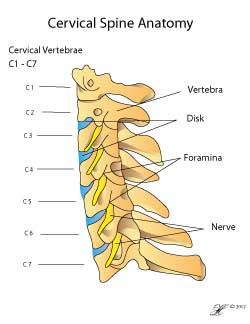
Diagram of the Cervical Spine (neck) showing normal anatomy
Neck pain is a common complaint and most causes of neck pain are not serious.
The support structures in the neck are made up of vertebrae (block-shaped bones) and ligaments (thick bands) that support the neck and allow it to move and carry the weight of the head. Because the neck is relatively less protected than the rest of the spine, it is more vulnerable to injuries that will lead to pain and restricted movements.
For some, neck pain will be a temporary issue and it will resolve with time. For others it can be a debilitating problem and require treatment.
Symptoms
You should consult a doctor for neck pain if:
- The pain occurs after an injury or blow to the head.
- Fever or headache accompanies the neck pain.
- A stiff neck prevents you from touching your chin to your chest
- The pain shoots down one arm.
- There is tingling, numbness or weakness in your arms or hands.
- The neck symptoms are associated with leg weakness or loss of coordination in arms or legs.
- The pain does not respond to over-the-counter pain medication (Panadol etc.).
- The pain does not improve after a week.
Causes
Neck pain may be caused by:
- Disc degeneration.
- Narrowing of the spinal canal from bone spurs or herniated discs.
- Arthritis of the neck bones (cervical spondylosis) causing disc herniation or bone spurs to form.
- Poor posture.
- Sudden severe injury to the neck causing disc herniation, whiplash, blood vessel destruction and vertebral injury.
- In rare cases – cancer or meningitis.
Risk Factors
- Age, as wear in the neck joints and discs becomes more common from middle age onwards
- Work or hobbies that hold the neck in one position for long periods: desk work, driving, phone and tablet use
- A workstation set up badly, such as a screen that is too low or no support for the forearms
- Previous neck injury, including whiplash
- Carrying heavy or uneven loads, such as a bag on one shoulder
- Smoking, which is associated with more neck and back pain
- Stress and poor sleep, which raise muscle tension and make pain harder to tolerate
- Inflammatory joint conditions such as rheumatoid arthritis
Investigations
Diagnosis is made by a doctor based on your history, symptoms, a physical examination, and results of diagnostic studies, if necessary. Some patients may be treated conservatively and then undergo imaging studies if medication and physical therapy are ineffective. These tests may include:
- Computed Tomography Scan (CT or CAT scan)
- Discography
- Electromyography (EMG)
- Nerve Conduction Studies (NCS)
- Magnetic Resonance Imaging (MRI)
- Myelogram
- Selective Nerve Root Block
- X-rays
Complications
Most neck pain settles without complication. Where it does not:
- Pain that persists for months, sometimes with lasting stiffness
- Pressure on a nerve root, causing pain, numbness, tingling or weakness travelling into the shoulder, arm or hand. See cervical radiculopathy.
- Pressure on the spinal cord itself, which causes clumsy hands, difficulty with buttons or handwriting, and unsteadiness on your feet. This needs prompt medical assessment.
- Headaches that start in the neck and are felt at the back of the head
- Disturbed sleep and reduced activity, which tend to make pain harder to shift
Treatment
Things you can do yourself. Most neck pain improves within a few weeks.
- Keep moving. Prolonged rest stiffens the neck and slows recovery.
- Heat or cold, whichever you find more comfortable
- Simple pain relief such as paracetamol, or anti-inflammatories if they are suitable for you (ask your pharmacist or doctor)
- Adjust your workstation so the screen is at eye level and your forearms are supported
- Sleep with one pillow that keeps your neck in line with the rest of your spine
Physiotherapy helps where pain is persistent or keeps returning, using a mix of strengthening, movement and advice on posture and daily habits.
Other treatments. For pain lasting longer, a supervised exercise programme is usually the next step. Injections around an irritated facet joint or nerve are occasionally used, more to identify the source of pain than to cure it.
Surgery is rarely needed for neck pain alone. It is considered when scans show convincing pressure on a nerve or the spinal cord that matches your symptoms, and other treatment has not helped. See disc surgery.
Seeking Advice
Your Family Doctor (GP)
Your Family Doctor will be able to diagnose and help treat your problem. He or she will be able to
- tell you about your problem
- advise you of the best treatment methods
- prescribe you medications
- and if necessary, refer you to Specialists (Consultants) for further treatment
Prevention
- Set your screen at eye level, with your chair supporting your lower back and elbows near a right angle
- Break up long periods in one position with a few minutes of movement every half hour
- Don’t cradle the phone between your ear and shoulder
- Carry a backpack over both shoulders rather than a bag on one side
- Stay generally active, and include exercises that strengthen the neck and shoulder girdle
- Use one pillow that keeps your neck level with your spine, and avoid sleeping on your front
- If you smoke, stopping helps
F.A.Q. | Frequently Asked Questions
How long should I wait before seeing someone?
Most neck pain settles within a week or two. See a doctor if it is not improving after a week, or sooner if you have any of the warning signs listed under Symptoms.
Should I wear a collar?
Usually not. Soft collars let the neck muscles weaken and tend to prolong recovery. The exception is when you have been specifically told to wear one after an injury.
Is my pillow to blame?
Sometimes. One pillow that keeps the neck in line with the spine suits most people. Waking with a stiff neck that eases within an hour is common and rarely serious.
Do I need a scan?
Most people do not. Scans very often show wear that is normal for your age and does not explain the pain. They are recommended when there are signs of nerve or spinal cord involvement, or after significant injury.
Can neck pain cause headaches?
Yes. Pain arising in the neck is often felt at the back of the head and up over the scalp, usually alongside neck stiffness.