
Subtalar dislocation refers to separation of the tarsal bones in the foot, including the calcaneus (heel bone) and navicular bones, from the talus. It is a painful but rare injury that usually occurs in high-impact sports like basketball.
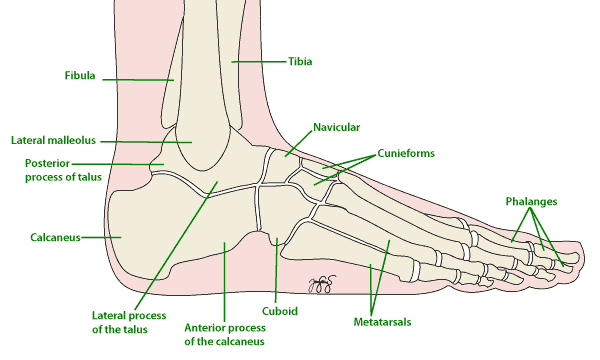
A great deal of force is required to cause this dislocation, and as a result there may be significant injury to other structures in the foot, including tendons, ligaments and occasionally bones, with fractures frequently affecting the ankle (malleoli), navicular, calcaneus and talus bones and sometimes the fifth metatarsal.
If the skin has not been broken and there are no fractures, a doctor or surgeon should be able to re-locate the joints in the emergency department or the operating theatre. When this is the case, recovery following this injury is rapid, with a cast and crutches for around six weeks and rehabilitation for several more weeks.
Most people with uncomplicated subtalar dislocation have only mild stiffness and/or arthritis in the foot in later life. However, athletes are encouraged to wear ankle supports and/or orthotics during sports to prevent re-injury during the first 6 months to a year of the dislocation.
Symptoms
Symptoms of subtalar dislocation include:
- Severe sudden pain following the injury
- Obvious deformity and abnormality of the foot
- Instability and inability to weight-bear
- Reduced and painful movements at the subtalar joints, including inward twisting (inversion) and outward twisting (eversion) of the foot
- Swelling, redness and bruising may develop in the hours after the injury.
If the dislocation has torn or trapped tendons surrounding the ankle, there can also be symptoms of pain moving up along the sides of the ankle.
Occasionally, blood vessels or nerves may be injured, leading to tingling, numbness or blue toes.
Causes
Subtalar dislocation is usually caused by severe inward twisting (inversion) of the foot. Most commonly, this occurs when a runner changes direction suddenly or is forced to a sudden stop.
Occasionally, the foot will dislocate forwards, backwards or outwards (eversion) from the joint. This is much rarer.
Other causes of subtalar dislocation include:
- Car accidents
- Falls
Risk Factors
Risk factors for this injury include:
- Playing high-impact sports like basketball
- Previous injury to the ankle or foot
- This injury more commonly occurs in young men
Investigations
Although the dislocation is often obvious to you as well as your doctor, a number of X-rays and images need to be taken to confirm that bones in the foot are not fractured and other small joints have not dislocated. This usually involves:
- A series of X-rays in different positions
- A CT scan.
Complications
Potential complications of a subtalar dislocation include:
- The most common complication following this injury is post-traumatic arthritis in the foot and stiffness. Some people also develop instability in the foot.
- Fractures of the tarsal bones or malleoli (ankle). In addition, the talus, calcaneus and navicular bones may have microfractures along their surfaces (osteochondral fracture) that occur from the rubbing of the bones together.
- Infection – osteomyelitis
- Osteonecrosis of the talus
Treatment
When there are no fractures and the skin has not been broken, the treatment for a subtalar dislocation is to relocate the bones as quickly as possible. To do this, your doctors will need to give you strong pain-killers, and may need to give you muscle-relaxants, sedatives or put you to sleep (general anaesthesia). Note that if ligaments or other tissues are caught between the bones, your surgeon may need to cut open the skin to relocate the ligament and allow the bones to be relocated.
Once this is done, your doctor or surgeon will order X-rays and/or CT scans to check your foot is in the correct place. Your foot will also be carefully assessed for signs of blood vessel or nerve injury.
After this, your ankle will be placed in a brace or cast for around 2 weeks. During this time, you cannot put any weight on your foot. You will consequently need to use crutches. Your physiotherapist will show you exercises to keep your toes moving and the muscles in your legs and thighs supple and strong.

In the first few days after your injury, your ankle and foot can swell significantly. You need to prevent this by keeping your foot elevated as much as possible, with multiple pillows under your foot at night-time and keeping your foot up on a chair when sitting.
If everything seems to be healing well after two weeks, your plaster will be replaced with a removable boot and you can start careful weight-bearing with crutches. During this time, your physiotherapist will start to show you exercises to regain strength, range of motion and flexibility in your foot. In your long-term rehabilitation program, your physio will also show you proprioception training exercises and balance training.
What about pain?
Your doctor will prescribe strong pain-killers for you while in hospital, and then weaker painkillers for when you go home. After this period, you can continue to use over-the-counter pain medications, however if severe pain persists or gets worse please see your doctor.
Other medications that your doctors may prescribe include:
- Tetanus shot and Antibiotics – this is usually only necessary when the skin has been broken
What if I have fractures?
When dislocation is complicated by fractures, you may require a longer period of non-weight-bearing with a cast, a longer rehabilitation program and surgery.
Seeking Advice
Any dislocations of the foot or ankle need to be seen by a doctor immediately, and if possible, an orthopaedic surgeon.
Once your foot has been relocated, you can talk to your surgeon, physiotherapist or family doctor about any concerns you have.
Your Family Doctor (GP)
Your Family Doctor will be able to diagnose and help treat your problem. He or she will be able to
- tell you about your problem
- advise you of the best treatment methods
- prescribe you medications
- and if necessary, refer you to Specialists (Consultants) for further treatment
Prevention
This injury happens when the foot is twisted hard, usually in sport or in a fall from a height. There is no sure way to prevent it. These steps lower the risk of bad ankle and foot injuries in general.
- Wear shoes made for your sport and for the ground you are on. Replace them when they wear out.
- Do balance training. This lowers the risk of ankle injuries in sport.
- Build up the muscles around your ankle and foot.
- Finish your rehab after any ankle injury before you go back to sport.
- Take care on uneven ground. Keep stairs and paths well lit.
- If you have hurt your ankle before, taping or a brace can help during high-risk sport.
F.A.Q. | Frequently Asked Questions
Why did my foot need to be put back so quickly?
The longer the bones stay out of place, the more the skin and the blood supply are stretched. Putting the joint back early protects the skin and lowers the risk of lasting damage.
Will I get arthritis in the foot?
It is common after this injury, even when everything is treated well. This is because of the force it took to cause the dislocation in the first place. Good treatment lowers the risk but cannot remove it.
How long will I be in a cast?
Usually several weeks, and you will not put weight through the foot at first. If you also broke a bone, it takes longer. Your surgeon will give you the timing.
Will I need an operation?
Many people do not. If the joint goes back into place easily and no bones are broken, a cast is often enough. Surgery is needed when the joint will not go back, when bones are broken, or when the skin is damaged.
When can I walk normally again?
Most people are walking without aids within a few months. Stiffness in the foot is common and can take longer to settle.
Will my foot ever feel the same?
Many people notice some lasting stiffness, and some have aching after a long day. Most get back to everyday activity without much trouble.
When can I go back to sport?
Later than you would expect, often six months or more. It depends on whether bones were broken and how the joint is doing.
What should I watch for at home?
Call your doctor if the pain gets worse rather than better, if your toes turn pale, blue or numb, if the cast gets wet or damaged, or if you get a fever.
References
Biswas, S., Murphy, M., ‘Subtalar Dislocation, The Internet Journal of Orthopedic Surgery, Vol. 3, No. 2, 2006.
Bryant, J., Levis, J. T., ‘Subtalar Dislocation’, Western Journal of Emergency Medicine, Vol 10, No. 2, 2009.
Delee, Drez, Miller, ‘Orthopaedic Sports Medicine: Principles and Practice’, 3rd Ed., Saunders Elsevier, 2010, pp 1952–1953.
Jungbluth, P., et al., ‘Isolated Subtalar Dislocation’, The Journal of Bone & Joint Surgery, Vol. 92, Iss. 4, April 2010, pp. 890–894.
McStay, C. M., et al., ‘Foot Dislocation’, Medscape Reference, http://emedicine.medscape.com/article/823168-overview.