
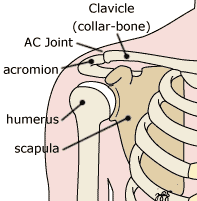
Your shoulder joint is a type of ball and socket joint. The ball is the end of your humerus (upper arm bone) called your humeral head and the socket is part of your shoulder blade (scapula) called your glenoid. This type of joint allows your shoulder to be very flexible and allows you to have a great range of movement with your shoulder and arm.
Your shoulder joint is lined with smooth glistening articular cartilage, which allows pain-free smooth movement.
Osteoarthritis is the most common type of shoulder arthritis. Also called wear-and-tear arthritis or degenerative joint disease, the cartilage is progressively worn away. As the protective cartilage surface of the joint is worn away by shoulder arthritis, bare bone is exposed within the shoulder.
The other common type of shoulder arthritis is rheumatoid arthritis. Rheumatoid arthritis is a condition that causes inflammation of the lining of the joints. This inflammation can, over time, invade and destroy the cartilage and bone.

Symptoms
Shoulder arthritis usually comes on slowly over years. The signs and symptoms include:
- Pain deep in the shoulder, often aching into the upper arm
- Pain that is worse with use, and often worse at the end of the day
- Pain at night that stops you sleeping on that side
- Stiffness, so that reaching behind your back or up to a shelf becomes harder
- Grinding, clicking or catching on movement
Many people find that they gradually stop using the arm without noticing, which is often the first thing a family member points out.
Causes
The most common cause is osteoarthritis, in which the smooth cartilage lining the joint wears away over the years. Other causes include:
- Rheumatoid arthritis, where the immune system attacks the lining of the joint
- Arthritis after injury, where a break or dislocation years earlier damaged the joint surface
- Rotator cuff arthritis, where a large tear left untreated allows the joint to wear unevenly
- Loss of blood supply to the ball of the joint, causing the bone to collapse
Where the rotator cuff no longer works, the ball no longer sits properly in the socket, and the joint wears in an unusual pattern. This matters later, because it changes which operation is suitable.
Risk Factors
Most people with shoulder arthritis are over 50. Other factors that increase the risk include:
- A past shoulder break or dislocation
- A large rotator cuff tear that was never repaired
- Rheumatoid arthritis or another inflammatory joint disease
- Heavy manual work or years of overhead loading
- A family history of arthritis
- Long-term steroid use or heavy alcohol use, which can affect the blood supply to bone
Investigations
Your doctor will examine the shoulder and check how far it moves and where it hurts. Tests that may be used include:
- X-ray, the main test, which shows narrowing of the joint, bone spurs and the shape of the joint
- CT scan, which gives more detail of the bone and is often used when planning a replacement
- MRI, which shows the rotator cuff
The state of the rotator cuff is important, because it decides which type of replacement will suit you.
Complications
Shoulder arthritis is not dangerous, but as it progresses it can cause:
- Pain that carries on and disturbs sleep
- Stiffness that limits dressing, washing your hair and reaching a shelf
- Muscle wasting from using the arm less
- Tearing of the rotator cuff over time
- Loss of independence in tasks needing the arm above shoulder height
Treatment
There is no cure for arthritis, but a great deal can be done to control the symptoms. Non-surgical treatment includes:
- Gentle range of movement exercises, which stop the shoulder stiffening further
- Cutting down heavy lifting and repeated overhead work
- Simple pain relief and anti-inflammatory medication
- Heat before activity and ice afterwards
- A steroid injection into the joint, which can settle a bad patch for weeks or months
A shoulder replacement is considered when the pain is severe, sleep is disturbed, and these measures have stopped working. Which type suits you depends on the state of your rotator cuff. Where the cuff is badly torn, a reverse shoulder replacement is usually used instead.
Prevention
Wear and tear cannot be prevented, but you can influence how much it limits you:
- Keep the muscles around the shoulder and shoulder blade strong
- Deal with rotator cuff problems early rather than leaving them
- Keep the shoulder moving, as stiffness makes arthritis harder to live with
- Keep to a healthy weight and stay generally active
- Stop smoking, which helps healing if you ever need surgery
F.A.Q. | Frequently Asked Questions
How do I know if my shoulder pain is arthritis?
Arthritis causes a deep ache in the shoulder, stiffness that limits reaching behind the back and overhead, and a grinding feeling with movement. It comes on slowly over years. An X-ray shows loss of joint space and bony spurs.
Can I avoid a shoulder replacement?
Many people manage for years with activity changes, physiotherapy to keep the shoulder moving, pain relief and occasional cortisone injections. Surgery is for pain that stops you sleeping or doing what you need to do, not for the X-ray.
What are the surgical options?
A standard shoulder replacement replaces the ball and socket and needs working rotator cuff tendons. A reverse shoulder replacement swaps the ball and socket around and is used when the tendons are torn. Your surgeon chooses based on your tendons, bone and age.
How long does a shoulder replacement last?
Most last 15 to 20 years or more. Younger and more active people wear them out sooner, which is one reason surgery is delayed where possible.