
What is AC Joint Arthritis?
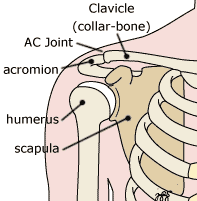
The acromioclavicular joint or AC joint is located at the top of your shoulder and is where your shoulder blade (scapula) meets the end of your collarbone (clavicle).
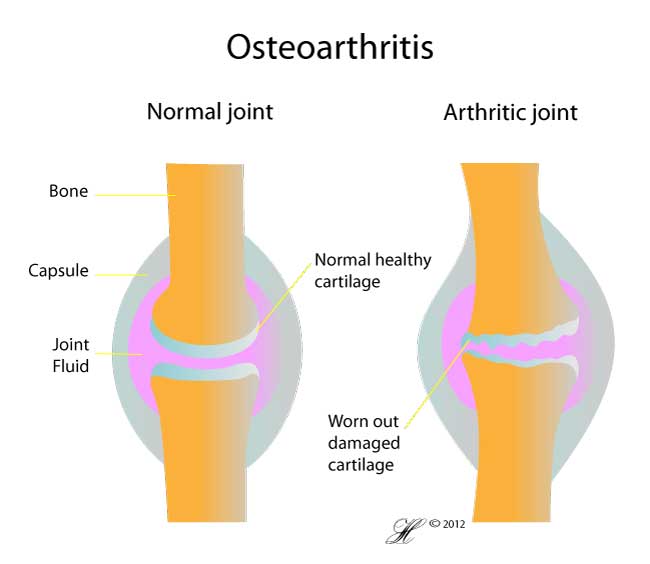
Arthritis occurs when the smooth glistening cartilage that lines the joint wears away.
AC Joint arthritis is not the same as shoulder arthritis. Doctors usually refer to glenohumeral joint arthritis as ‘shoulder arthritis’.
Your glenohumeral joint is actually your shoulder joint. Your shoulder is where the end of your humerus (upper arm bone) called your humeral head meets the part of your shoulder blade (scapula) called your glenoid.
Symptoms
What are the symptoms of AC arthritis?
AC Joint arthritis usually causes pain around the top of the shoulder, but can also seem to affect the neck, chest and inside the shoulder joint itself. This pain tends to be brought on by certain movements, and may get worse during the day as the shoulder is used.
Other symptoms include a clicking sensation when the shoulder is used, and swelling and tenderness over the bone.
A good test to perform on yourself is called the Cross Chest Compression Test. Cross the affected arm across your chest, putting your hand on the other shoulder. If this elicits your pain, it is likely you have AC arthritis, however it’s important to get a physiotherapist or doctor’s opinion.
What causes AC joint arthritis?
AC Joint arthritis is the result of repetitive movements that wear away the protective cartilage surface lining the acromioclavicular joint. In particular, movements that strain this joint include:
- Lifting heavy objects overhead
- Crossing your arms across your chest
Sometimes injuring your shoulder can lead to prematurely developing AC joint arthritis.
Risk Factors
- Heavy lifting, including weight-lifting
- Certain jobs – jobs that involve holding your arm above shoulder height can predispose to AC joint arthritis
- Previous dislocations of the AC joint
Investigations
X-ray
Severe arthritis of the AC joint can be diagnosed with an X-ray of the shoulder.
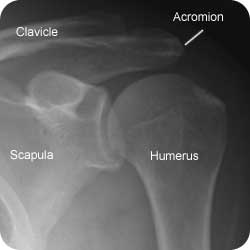
An X-ray of the Left Shoulder showing normal anatomy
MRI
MRI is a very sensitive test and can diagnose arthritis of the AC joint when it is mild.
What are the complications of AC Joint Arthritis?
While AC arthritis is often very painful, it generally does not cause any other problems.
However, AC joint arthritis often occurs simultaneously with other conditions, including:
- rotator cuff tears
- shoulder bursitis
- biceps tendon problems
- osteoarthritis of the shoulder joint
How is AC Joint arthritis treated?
It depends on the severity of your symptoms and the presence of other shoulder problems such as shoulder impingement syndrome, rotator cuff tears and glenohumeral arthritis.
Mild to moderate pain can be treated with anti-inflammatory medications and physiotherapy.
Treatment
Most people with AC joint arthritis improve without an operation. Non-surgical treatment includes:
- Cutting back on lifting above the head and reaching across the body
- Simple pain relief and anti-inflammatory medication
- An ice pack on the top of the shoulder to settle a flare
- Physiotherapy to build up the muscles around the shoulder blade and rotator cuff
- A steroid injection into the AC joint
Lifting overhead and reaching across the body are the two movements that load the joint most, and in the gym the bench press and dips are common culprits. Physiotherapy changes how the shoulder moves and takes load off the joint.
An injection can ease the pain for weeks or months. It also helps to confirm that the AC joint is the source of the pain, which matters if surgery is being considered. These measures deserve a proper trial first, as most people do not need to go further.
Surgery
If the symptoms do not respond to conservative treatment, or if the pain is too severe, then AC-joint surgery may be necessary.
The surgical procedure involves removing the end of the clavicle (collarbone). This gives more space for the AC joint movement, and prevents the ends of the clavicle and acromion from rubbing against each other.
The surgery may be performed through a small incision directly over the joint or by keyhole surgery (arthroscopy).
See acromioclavicular joint excision for more about the operation.
Seeking Advice
Physiotherapist
A physiotherapist can perform an assessment of your shoulder pain and can then:
- Prescribe exercises
- Reduce pain
- Discuss the need to see a GP
Your Family Doctor (GP)
Your Family Doctor will be able to diagnose and help treat your problem. He or she will be able to
- tell you about your problem
- advise you of the best treatment methods
- prescribe you medications
- and if necessary, refer you to physiotherapists and surgeons for further treatment
Prevention
AC joint arthritis is caused by wear and tear, and sometimes by injuries.
Unfortunately, if your job or sport involves heavy lifting or strain of your shoulder, you are more likely to develop AC joint arthritis.
You can try to avoid exacerbating your pain by resting and protecting your shoulder when you feel pain starting to develop.