
What is an ankle fracture?
The ankle joint is composed of 3 bones:
- tibia (shin bone),
- fibula and
- talus.
An ankle fracture is a break near the lower ends of the two leg bones, the tibia and fibula. You can feel these as bony bumps on either side of your ankle. These areas of the bone are known as the ‘malleoli’. A break can affect one or both bony bumps on either side of the ankle. In some serious breaks, the talus bone is also involved. The talus is the first bone of the foot which connects to the leg bones (tibia and fibula).
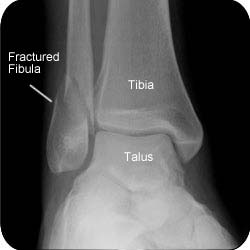
Ankle fractures are common injuries that are most often caused by your ankle joint rolling inward or outward.
The treatment of an ankle fracture and the time taken to heal will depend on many factors, including:
- the type of ankle fracture and whether there is dislocation
- where the bone is broken,
- how many of the bones are broken
- the condition of your skin over the fracture.
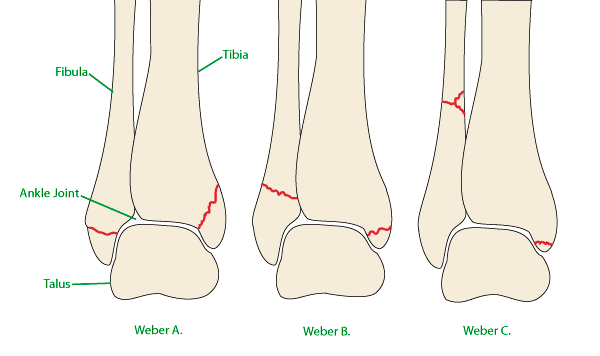
A common way of classifying fractures is the Weber System. This system is based on the relationship between the two large bones – the fibula and tibia. Just above the ankle, the two leg bones are joined by a strong band called the syndesmosis. It helps keep the ankle steady.
The first type of ankle fracture, the Weber A, shows breaks in the bones below the syndesmosis. In a Weber A fracture, the tough band that joins the two leg bones above the ankle is not damaged, so the ankle stays steady. These breaks usually heal well in a simple cast. In contrast, the Weber B and C types will frequently require surgery to stabilise them.
The treatment of your ankle fracture can either be:
- a simple plaster cast
- surgery with typically a combination of screws and plates.
Symptoms
Ankle fractures can be very painful, though small breaks may only be a little sore. Other features include:
- Inability to stand on your foot
- Deformity – the ankle looks twisted or abnormal.
- Bruising and swelling
Causes
Like many fractures, the causes fall into two groups:
- ‘High-energy’ fractures: Large forces on strong bones
- Ankle fractures are common among sports people who sustain high-speed falls and trauma
- Other common causes of high-energy fractures are car accidents and falls from large heights
- ‘Low-energy’ fractures: Small forces on weak bones
- In people with weak bones, almost any awkward movement can cause a fracture. Weakness in bones can be due to
- Osteoporosis
- Some medicines. People who take high doses of steroids for a long time are most at risk of weak bones
- Pathological fractures. Doctors use this name when something has weakened one area of bone and made it break. This includes things like infection or cancer, but these rarely cause ankle fractures.
Risk Factors
Risk factors for getting an ankle fracture include:
- Playing high-energy or contact sports
- Having weak bones – this can be caused by osteoporosis, some medications (e.g. prednisolone or other steroids), advanced age
- Things that make falls more likely, such as dizziness, older age, heart or liver disease, and poor diet.
How is it diagnosed?
Your doctor can often tell your ankle is broken by looking and feeling. They will usually order an X-ray to confirm it and check for other breaks.
If the break is hard to see, or the ligaments and muscles around the joint are hurt, the doctor may order a CT or MRI scan. Unlike an X-ray, CTs and MRIs give clear, detailed pictures of the soft tissues.
Blood vessels run around the ankle and are sometimes damaged. Your doctor can usually check these blood vessels by looking at and feeling your foot. Sometimes a special scan called an angiogram is needed. Sometimes, a specialist called a vascular surgeon may get involved. X-ray of the ankle showing a severe fracture and dislocation of the ankle joint. The tibia has been broken into many parts.
Could I have something other than an ankle fracture?
Conditions that may imitate an ankle fracture include:
- Ankle sprain : This is an injury to the soft tissues (ligaments and tendons) around the ankle joint.
- Fracture in the other bones around the ankle, for example the talus or calcaneus
Complications
Are there any complications that I need to be aware of?
General complications after an ankle fracture include:
- Stiffness of the foot and ankle
- Pain
- Swelling
- Arthritis in later life – One of the most common long-term complications affecting your broken ankle is osteoarthritis, or just arthritis. When bones around the joint have broken they are likely to undergo more severe wear and tear than non-injured joints. This causes pain and swelling in the joint and may be severe enough to warrant further treatment.
- Inadequate healing – the position of the bones in the ankle is very important. This is why the bones must be put back in exactly the right place, with a plaster or an operation, so they heal properly.
If you need an operation, there are general risks of surgery and some that are specific to the ankle:
- Injury to nerves – Numbness or tingling can occur at the wound or in the foot. This is usually temporary but in some it may be permanent.
- Compartment Syndrome – this occurs when pressure in the foot and ankle, either from swelling or a plaster, cuts off the circulation to the foot. The lack of blood causes severe pain, numbness or tingling, and can damage the small muscles in the foot for good.
- Need for further surgery:
- The metalwork may need to be removed if it becomes prominent or problematic
- Failure of the bones to heal or incorrect position may result in a salvage operation or arthrodesis.
There are a number of general complications that apply to any surgery. For more information, see Complications of Surgery.
What is the treatment?
This depends upon the type and severity of the injury and is decided by a consultant and their team.
Non-surgical treatment
If the fracture is stable (the broken ends do not move) and it is in a good position, it can be treated with a below-knee cast or a removable boot. Weight-bearing is permitted for stable fractures but not for unstable fractures.
Surgical treatment
If the fracture is very unstable (Weber B/C) or displaced, surgery may be required to reset or “fix” the bones in the correct position. This may involve:
- Immediate surgery. When the fracture is uncomplicated plates and screws may be used to fix the fracture.
- Staged surgery. If the tissues around the joint are badly hurt, the ankle needs to rest for a short time before surgery. This allows the swelling and inflammation in the tissues to go down. In the intervening period, the ankle is positioned then held in place by external fixation. This can be a nuisance and sometimes uncomfortable, but the open frame lets the skin and soft tissue heal. It also lets staff check the leg and quickly treat problems such as large bruises or infection. Once the soft tissues are considered safe, surgery will go ahead to fix the joint permanently.
There are a few ways to do the operation. Whichever is used, you will not be able to put weight on the leg for at least 2 weeks while the wounds and bone heal.
For many, non-weight-bearing is a frustrating experience. Using crutches or hopping limits what you can do, and can affect your return to work. However, the newly set bones must not be over-strained. A hospital physiotherapist will choose a walking aid for you, teach you how to get around and check you can manage stairs.
For more about the operation and recovery, see Surgery for Ankle Fractures.
What about pain?
In hospital, staff will check on you and give you pain relief as needed. You will be given instructions on management of the pain by nursing staff before you leave hospital.
Whether you have surgery or not, swelling is quite common. To reduce swelling, keep your foot raised above your waist for 50 minutes of every hour for the first two weeks after surgery.
Seeking Advice
Your Family Doctor (GP)
Your GP (family doctor) can find out what is wrong and help treat it. Your GP can
- tell you about your problem
- tell you the best ways to treat it
- give you medicine if you need it
- send you to a specialist if you need one
You may first go to an emergency department or urgent care clinic. If the broken pieces are not lined up well enough to heal in a cast, you may be sent to an orthopaedic surgeon.
What you can do
You may want to write a list that includes:
- A clear account of your symptoms
- Health problems you have had
- Health problems your parents, brothers or sisters have had
- All the medicines and supplements you take
- Questions you want to ask the doctor
Prevention
As many ankle fractures are caused by car accidents or sports injuries they cannot be prevented. If you are at risk of osteoporosis (especially women over 50), see your GP for a bone test and treatment to protect your bones.
F.A.Q. | Frequently Asked Questions
Will I be allowed to weight-bear on my leg?
Follow your doctor’s advice about whether you can walk or put weight on your foot. This advice will be specific to your injury and your treatment (surgery or just a cast).
With some ankle fractures that are relatively minor, you are able to weight-bear on your ankle. If this is the case, you will not be placed in plaster but in a special boot and will be able to weight-bear as tolerated.
All other types of ankle fractures require being placed in plaster. When you are in plaster you may not take any weight on that leg (see non-weight-bearing). Consequently, you will need crutches or a wheelchair to get around. Your recovery will depend on the type of the fracture and method of treatment.
What should I do if I have a problem?
Tell your GP if you have bad pain, a lot of swelling, redness or fluid leaking from the wound. If necessary, go to your local emergency department.
Will I be ok long-term? What should I expect in the future?
More complex, unstable breaks usually take longer to recover from. This is not however a hard and fast rule. Most people have some trouble with these ankle movements:
- Flexibility
- Range of movement (ROM) – this term refers to how far you can move your ankle. Soon after the cast comes off, many people find the ankle is stiff. This slowly gets better with physiotherapy and time, but small limits may stay for good. Your surgeon and physiotherapist can give you some idea of what to expect. But everyone heals differently, and no one can say exactly how well your ankle will work again.
- Osteoarthritis and other joints – it’s important to remember that the ankle is part of a system involved in walking. This includes the knee, hip, lower back and the other leg. A problem in one part can affect the others. A small change in the shape of the ankle can make arthritis in the knee, hip or back more likely later in life.
More Information
You can find more about fractures, treatment and support services on these sites:
- Healthdirect – free Australian government health information and a nurse helpline
- Better Health Channel – Victorian government health information
- myDr – Australian health information written by doctors
- PEDro – a database of physiotherapy research
- Cochrane Library – plain-language summaries of medical research
Medical sources on Fifth Metatarsal Fractures:
The latest research on fifth metatarsal fractures is accessible through the Cochrane Library and PubMed Database.
References
McCormack, A. P., Chapter 30: Ankle Fractures, ‘Treatment & Rehabilitation of Fractures’, Hoppenfeld, S., Murthy, V. (Eds), Lippincott Williams and Wilkins, USA, 2000.
Porter, D. A., ‘Functional Outcome after Operative Treatment for Ankle Fractures in Young Athletes: A Retrospective Case Series’, Foot and Ankle International, Vol. 29, No. 9, September 2008, pp 887–894.
Skinner, H. B., ‘Current Diagnosis and Treatment in Orthopaedics’, 4th Ed.
Yufit, P., Seligson D., ‘Malleolar ankle fractures. A guide to evaluation and treatment’, Orthopaedics and Trauma, Vol. 24, Iss. 4, August 2010, pp 286–297.
Wang, R., et al., ‘One year follow-up after operative ankle fractures: A prospective gait analysis study with a multi-segment foot model’, Gait & Posture, Vol. 31, Iss. 2, February 2010, pp 234–240.
