
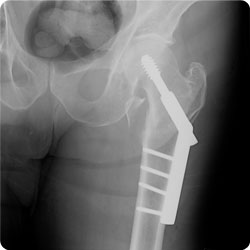
 X-ray of a hip fracture that has been fixed with surgical plates and screws called a DHS
Treatment
Treatment usually means an operation to fix or replace the broken bone. The operation is done as soon as possible, ideally within 48 hours, so you can start walking and recovering.
Surgery is best done within one or two days of arriving in hospital. If you take aspirin or clopidogrel, surgery is usually not delayed. Waiting longer causes more problems than the small amount of extra bleeding.
Care from both a bone surgeon and a doctor for older people helps recovery. Being seen early by a doctor who cares for older people is linked to fewer problems and a shorter hospital stay.
Tell me about the surgery
Surgery is the best way to treat a broken hip.
The type of surgery depends on:
- the type of fracture
- severity of the fracture
- your age
- your pre-existing medical health
- your mobility and ability to function independently before the fracture
What are the different ways surgeons use to fix a hip fracture?
Depending on the type of hip fracture, surgeons can use:
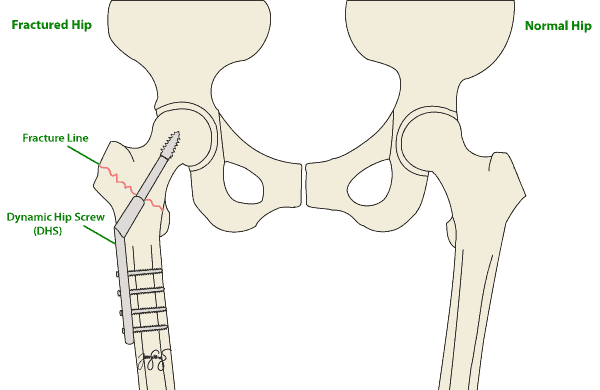
- Plates and Screws. This is called a DHS or Dynamic Hip Screw. In this operation, the surgeon places a large metal screw across the fracture. A plate is then attached to the screw. A number of smaller screws are then used to secure the plate to the femur bone.
- Screws alone. These are called Cannulated Screws.
- Surgical Nail or Rod. These are called Intramedullary Nails or IM Nails.
- Partial Hip Replacement. This is called a Hemiarthroplasty
- Full Hip Replacement. This is called a Total Hip Replacement or Total Hip Arthroplasty.
Rehabilitation | When can I start walking again?
Whatever operation you have, the aim is to get you up and moving soon, usually the day after.
Day 1 After the Operation
Your physiotherapist will help you get up and moving, often with the help of a walker. You will start physio, usually with exercises to help the hip move and get stronger.
Week 1 After the Operation
Most people stay in hospital for less than a week after surgery. Depending on your operation and the help you have at home, you may go to a rehab unit after hospital.
Within 1 month After the Operation
In rehab and at home, an occupational therapist can show you ways to manage on your own, such as using the toilet, washing, dressing and cooking. Your occupational therapist will check if a walking frame or wheelchair would help.
You may keep seeing a physio and occupational therapist as you recover.
Medications | What medications will I be given in hospital?
Apart from your usual medications, you will be given:
- Pain relief. There are several medicines and methods to ease your pain before and after the operation. Often, whilst in the emergency department, you will be given a nerve block to numb your legs. You may also be given pain relief as tablets or through a drip in your arm. Your anaesthetist may also numb the nerves to the hip with an injection, to ease pain before and after the operation.
- Bone strengthening. Many people who break a hip have thin, weak bones, a condition called osteoporosis. Blood tests are usually done to see if you need vitamins or other medicines for your bones.
Rehabilitation | Tell me about my exercises and recovery
Recovering from a hip fracture involves a lengthy period of rehabilitation. The goal of rehabilitation is to help you regain mobility. You’ll learn how to gradually place more weight on your hip until it can handle your full weight without pain. You’ll also learn how to sit, stand and walk so that you don’t re-injure your hip or damage your prosthesis, if you have one.
Will I need crutches, a frame or walking sticks?
Help with walking and other activities. After a hip fracture, you’ll need the help of a walking aid, such as a cane, walker or crutches, for a while. You may also need help getting around your home and doing daily tasks, such as bathing, dressing and cooking. Or you may need a stay in a rehab unit or care home to get help you cannot get at home.
How can I help heal my fracture?
You can help your recovery by following your doctor’s and therapist’s advice.
Does it work?
Does it work? Evidence for bone health and falls
What the research shows for preventing falls and broken bones, including exercise, hip protectors and bone medicines.
- Does vitamin D prevent broken bones? Probably does not help.
- Do calcium supplements prevent broken bones? Probably does not help.
- Does alendronate prevent broken bones in osteoporosis? Probably helps a little.
- Does exercise prevent falls in older people? Good evidence it helps.
- Do hip protectors prevent hip fractures? Probably helps a little, in care homes.
References
- Vazquez O, Belaieff W, Gamulin A, DiGiovanni PL, Cochard B, Hannouche D. Best practices in the management of proximal femoral fractures in elderly patients on the ward. A narrative review. EFORT Open Rev. 2026, 11(3), 233-242. PMID 41770042.
- Lu W, Yon DK, Lee SW, Koyanagi A, Smith L, Shin JI, Rahmati M, Xiao W, Li Y. Safety of Early Surgery in Hip Fracture Patients Taking Clopidogrel and/or Aspirin. A Systematic Review and Meta-Analysis. J Arthroplasty. 2024, 39(5), 1374-1383.e3. PMID 37972664.
- Mazarello Paes V, Ting A, Masters J, Paes MVI, Graham SM, Costa ML, HIPCARE investigators. A systematic review of the association between early comprehensive geriatric assessment and outcomes in hip fracture care for older people. Bone Joint J. 2025, 107-B(6), 595-603. PMID 40449538.
