
Chronic ankle instability means the ankle keeps giving way, or feels as if it will. It usually follows one or more ankle sprains that stretched the ligaments on the outside of the ankle.
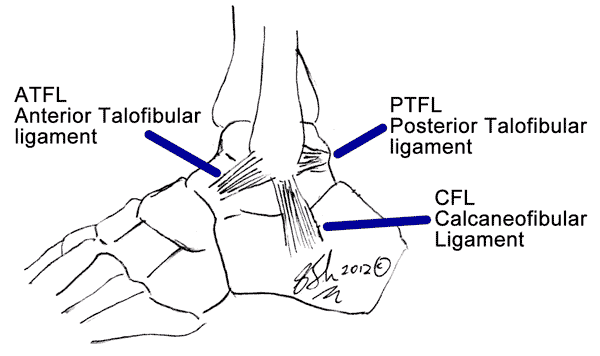
Ligaments are tough bands of tissue that hold bones together. They work like the guy ropes on a tent, keeping the joint steady. The ankle has a strong ligament on the inside and three weaker ligaments on the outside. The outside ligaments are the ones that tear in most sprains, so most instability is on the outer side of the ankle, and the foot tends to roll inwards.
When the ligaments are loose, the muscles on the outside of the lower leg (the peroneal muscles) can take over some of their job. Training these muscles is a big part of treatment.
It is common in people who play sports with jumping and quick changes of direction, such as basketball, netball and football.
Symptoms
What are the symptoms?
- A sense of weakness and instability in the joint – it feels as though the foot is always trying to collapse or ‘give out’.
- Difficulty walking on uneven surfaces
- Reduced proprioception – proprioception is the sense of the position of the joint in space. Someone with reduced proprioception in their ankle will sometimes find it difficult to maintain their balance and walk on uneven surfaces.
Causes
Chronic ankle instability nearly always starts with an ankle sprain. A sprain stretches or tears the ligaments on the outside of the ankle.
Ligaments heal slowly and sometimes heal a little loose. The small nerves in the ankle that sense position can also be damaged. If the ankle is not rehabilitated well, the muscles around it stay weak and the sense of balance does not return.
Each new sprain stretches the ligaments a little more. The ankle rolls more easily, which leads to more sprains. Over time this cycle can damage the joint surface and other parts of the foot.
Risk Factors
Things that make chronic ankle instability more likely:
- Past ankle sprains, especially ones that were never fully rehabilitated
- Sports with jumping, cutting and landing, such as basketball, netball and football
- A heel that tilts inwards (hindfoot varus), which loads the outer ligaments
- A small difference in the shape of the ankle bone (talus) that lets it twist out of place
- Loose joints in general, which some people are born with
- Weak muscles on the outer side of the lower leg (the peroneal muscles)
Investigations
A doctor or physiotherapist can usually diagnose chronic ankle instability by examining the ankle. The examination may include:
- Looking at and feeling the joints of the foot and ankle
- Checking how far the ankle moves, both when you move it and when the examiner moves it
- Testing the strength of the muscles around the ankle, especially the peroneal muscles on the outside
- Stability tests, where the examiner gently pulls the foot in different directions to feel how much the ligaments give
- Balance tests
The video below shows a physiotherapist testing the ligament across the front of the ankle. The normal left foot is shown first, then the loose right foot. The right foot slides too far forward when it is pulled.
Scans are not always needed. They are used when the ankle is not settling or when another injury is suspected:
- X-rays to look for arthritis or a small fracture. Stress X-rays, taken while the ankle is pushed, show how far it tilts
- MRI to show whether the ligaments are stretched or torn, and to look for damage to the cartilage
Complications
An unstable ankle keeps rolling, and each roll can cause more damage:
- More sprains, as instability causes sprains and sprains cause more instability
- Wear of the joint surface, which can lead to arthritis of the ankle over the years
- Damage to the cartilage or bone of the ankle, found in about two out of three people with long standing instability
- Pinching of tissues on the inner side of the ankle
- A flatter foot, as the ankle sits in an abnormal position
Other problems can feel like instability, so the doctor will also check for a torn tendon, weak peroneal muscles, a missed fracture and arthritis.
Treatment
Most people get better without surgery. Treatment aims to make the ankle strong and steady so it stops rolling.
Physiotherapy
This is the main treatment. A physiotherapist will give you a programme to improve:
- Balance, often using a wobble board. These exercises teach your brain where your foot is when you stand on it, and they build strength at the same time
- Strength, especially of the peroneal muscles on the outside of the lower leg, which take over the job of the loose ligaments
Most people improve a lot within six to twelve weeks of regular exercise. The gains last if you keep the exercises up. See Rehabilitation for Ankle Sprain for the kind of programme used.
Braces and taping
A brace or tape supports the ankle during sport and on uneven ground. They work best together with the exercises, not instead of them. An orthotist can fit a brace if a standard one does not suit.
While you wait to see a physiotherapist
- Take simple pain relief such as paracetamol if pain is a problem
- Use ice and put your foot up if the ankle is swollen
- Wear shoes or boots that support the ankle
- Take care on uneven ground
Many exercises for ankle instability are shown online. See a physiotherapist before starting them. Done the wrong way on an already injured ankle, they can cause more harm.
Surgery
Surgery is considered when the ankle is still unstable after a proper course of physiotherapy and bracing.
The usual operation tightens or rebuilds the stretched ligaments on the outside of the ankle. In some cases a piece of tendon is used to replace the lost ligament. Keyhole surgery (arthroscopy) may be done at the same time to look for and treat damage inside the joint. See Ankle Reconstruction (Lateral) for Instability.
After surgery the ankle is in a cast for about two weeks, then a removable brace so physiotherapy can start. Walking builds up over the next few weeks. Some people keep wearing a brace for sport in the long term.
Surgery may not be advised if:
- You have a lot of pain but only a little instability, as fixing the ligament will not fix the pain
- You have poor blood flow to the feet, which slows healing and raises the risk of infection
- You have numb feet from nerve damage (peripheral neuropathy)
Problems after surgery are uncommon but include:
- The ankle becoming unstable again, or stiff
- Slow wound healing or infection
- Damage to the small skin nerves on the outside of the foot, which can cause numbness or a painful nerve lump
Surgery aims to make the ankle stable, not to give you a new ankle. Some stiffness is common, and the ankle may not cope with every high demand sport. Talk with your surgeon about what you need the ankle to do, so you both have the same expectations.
Seeking Advice
Your Family Doctor (GP)
Your Family Doctor will be able to diagnose and help treat your problem. He or she will be able to
- tell you about your problem
- advise you of the best treatment methods
- prescribe you medications
- and if necessary, refer you to Specialists (Consultants) for further treatment
F.A.Q. | Frequently Asked Questions
Why does my ankle keep giving way?
After a sprain, the ligaments can heal a little loose. The nerves in the ankle that tell your brain where your foot is can also work less well. So the ankle rolls before you can react.
Will it get better on its own?
Usually not, if it has been going on for months. What does work is training. Balance and strength exercises rebuild the control you lost, and most people improve a lot with them.
How long do the exercises take to work?
Give it at least six to twelve weeks of regular work. Little and often beats one long session a week.
Do I need a scan?
Not usually. Your doctor or physiotherapist can tell by examining the ankle. Scans are used when the ankle is not settling, or to look for damage to the cartilage or a small break that was missed.
Should I wear a brace or tape my ankle?
These help during sport, especially early on and if you have rolled it many times. They work best alongside the exercises, not instead of them.
Will I need an operation?
Most people do not. Surgery is for ankles that stay unstable after a proper try at physiotherapy and bracing. It tightens or rebuilds the stretched ligaments.
Can I still play sport?
Yes, most people can. Do the exercises, use a brace or tape if you need to, and build back up rather than jumping straight in.
What happens if I ignore it?
Rolling the ankle again and again wears the joint surface. Over time this can lead to arthritis in the ankle.
More Information
Please note that the accuracy of any information provided by external sites is not guaranteed by Orthoanswer. Always discuss your condition with your doctor/health specialist.
- About.com provides lots of information about ankle sprains, instability, treatment options etc. http://orthopedics.about.com/cs/sprainsstrains/a/anklesprain_4.htm
- Pueblo Ankle and Foot Care is an American site that provides brief, easy-to-understand information about many foot and ankle conditions: http://www.puebloankleandfoot.com/conditions/chronic-ankle-instability
References
F. Bonnel, et al., ‘Chronic Ankle Instability: Biomechanics and pathomechanics of ligaments injury and associated lesions’, Orthopaedics and Traumatology: Surgery & Research, Vol 96, Iss. 4, June 2010, pp 424–432.
K. W. Chan, ‘Acute and chronic lateral ankle instability in the athlete’. Bulletin of the NYU Hospital for Joint Diseases, 2011, Vol. 69, Iss. 1, pp 17–26.
PO McKeon PO, et al., ‘Balance training improves function and postural control in those with chronic ankle instability’, Medical Science Sports Exercise, 2008, Vol 40, Iss. 10, pp 1810–1819.