
The shoulder is the most mobile joint in the human body. It is a ball and socket joint. The ball is made from the upper end of the arm bone (humerus), and the socket is made from part of the shoulder blade (glenoid). However, the wide range of movement of the shoulder comes at a price – it is susceptible to dislocation.
There are many structures in the shoulder joint that provide support and help the ball stay in the socket. These include ligaments, tendons, muscles and the fibrous capsule around the shoulder joint itself.
Shoulder instability occurs when the supporting structures of the shoulder joint aren’t doing their job properly. For various reasons, the ligaments, tendons, muscles or joint capsule become too loose around the shoulder, and it becomes prone to popping out of place (dislocating).
50% of all joint dislocations involve the shoulder, particularly in young people.
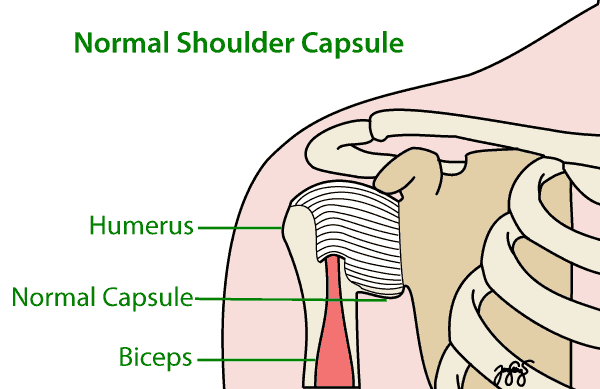
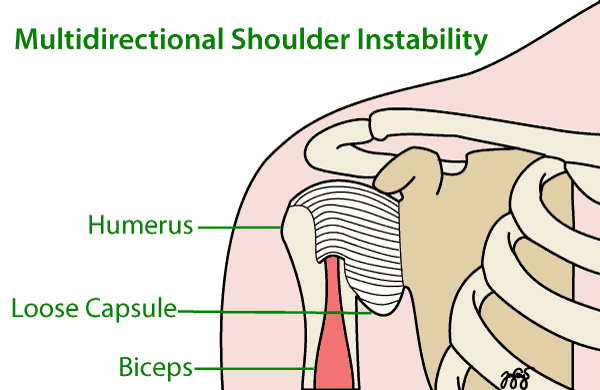
Symptoms
Symptoms of shoulder instability may include:
- Pain in the shoulder
- Multiple dislocations of the shoulder
- A feeling that the shoulder is loose or unstable in the joint
Causes
Shoulder instability occurs when the supporting structures around the shoulder become loose or weak. This can occur via several mechanisms, including:
- Single traumatic dislocation – once a healthy shoulder is dislocated, the ligaments around that shoulder may be damaged from the trauma, and become loose.
- Repetitive minor trauma – loose ligaments may also result from many years of strain on the shoulder. This is often from overhead activities, such as swimming, cricket (throwing), painting or plastering.
- Naturally loose ligaments – some people have shoulder instability with neither of the above two causes.
Risk Factors
You are at greater risk of shoulder instability if:
- You have previously dislocated your shoulder
- You have a history of rotator cuff tears
Also, younger patients are more likely to re-dislocate their shoulder once it has been dislocated.
Investigations
X-rays and an MRI scan may be ordered for shoulder instability. After a shoulder has dislocated, an MRI scan often shows damage, such as a small dent in the ball of the joint or a tear around the socket. In people with naturally loose shoulders the scans may look normal. They are useful in making sure there are no other problems with the shoulder, such as arthritis or rotator cuff problems.
The main way that shoulder instability is diagnosed is by examining the shoulder under a general anaesthetic. This allows the doctor to check for looseness in the ligaments and instability in the shoulder joint with all the muscles completely relaxed. The other investigation performed whilst under anaesthesia is a diagnostic arthroscopy. This is when a small cut is made near the shoulder, and the inside of the joint is inspected with a specialised camera.
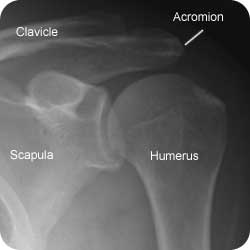
An X-ray of the Left Shoulder showing normal anatomy
Complications
Persistent pain
Shoulder dislocation
Need for surgery
Treatment
When this condition is first diagnosed, treatment involves:
- Anti-inflammatories, such as ibuprofen, to control pain
- Activity modification – avoid activities that make symptoms worse (such as swimming, tennis and other overhead activities)
- Exercises that aim to improve strength in the muscles around the shoulder and hence improve stability
If these measures are tried for a reasonable period of time and the instability persists, surgery may be necessary to repair the damaged ligaments around the shoulder under anaesthetic. Options include:
- Arthroscopy – this is when tiny cuts are made around the shoulder to allow a specialised camera and instruments to operate on the inside of the joint. Also known as keyhole surgery.
- Open surgery – this is when a larger cut is made around the shoulder to allow surgeons to look directly at the inside of the shoulder joint.
After surgery, the affected arm needs to be in a sling for a period of time. Physiotherapists can recommend an exercise plan for the shoulder which helps to prevent stiffness, increase the range of movement in the shoulder, and finally strengthen the shoulder.
Some loose shoulders slip in more than one direction without any injury. Exercises to strengthen the shoulder muscles are the first treatment for this kind of loose shoulder.
When part of the shoulder socket has worn away, a piece of donor bone from the ankle can be used to rebuild it.
Seeking Advice
Your Family Doctor (GP)
Your Family Doctor will be able to diagnose and help treat your problem. He or she will be able to
- tell you about your problem
- advise you of the best treatment methods
- prescribe you medications
- and if necessary, refer you to Specialists (Consultants) for further treatment
Prevention
The best way to prevent shoulder instability is to do exercises that strengthen the muscles around the shoulder – especially the rotator cuff. A physiotherapist can recommend a good exercise plan for this.
Avoidance of overhead activities, such as swimming, tennis, plastering and painting, may reduce the instability in the joint.
References
- Rutgers C, Verweij LPE, Priester-Vink S, van Deurzen DFP, Maas M, van den Bekerom MPJ. Recurrence in traumatic anterior shoulder dislocations increases the prevalence of Hill-Sachs and Bankart lesions. A systematic review and meta-analysis. Knee Surg Sports Traumatol Arthrosc. 2022, 30(6), 2130-2140. PMID 34988633.
- Housset V, Ho SWL, Lädermann A, Phua SKA, Hui SJ, Nourissat G. Multidirectional instability of the shoulder. A systematic review with a novel classification. EFORT Open Rev. 2024, 9(4), 285-296. PMID 38579775.
- Singh M, Byrne R, Chang K, Nadella A, Kutschke M, Callanan T, Owens BD. Distal Tibial Allograft for the Treatment of Anterior Shoulder Instability With Glenoid Bone Loss. A Systematic Review and Meta-analysis. Am J Sports Med. 2025, 53(1), 210-216. PMID 38384193.